

Gunpei Yokoi, who worked as an engineer at Nintendo, is best known for a design philosophy called “Lateral Thinking with Withered Technology” (枯れた技術の水平思考). It literally means that instead of chasing the latest technology, you take mature, stable, low-cost existing technology — so-called “withered” or outdated technology — to create a brand-new experience with creativity.
It sounds like an engineering philosophy, but it’s really marketing sense, and it splits into two directions:
Figure out first what the user actually wants, imagine a product that fits that need at a sensible cost and price, and only then pick the most suitable technology. Old technology may be dated, but it usually runs stable and mature, cheap, and is easier to find a market gap for. This is the opposite of “now that I have a new technology (say, AI), let me go figure out what impressive thing I can build with it.”
Not only rediscovering old technology, but rediscovering old products that had already faded — and, with the same creativity and lateral thinking, giving them a new lease on life.
Q: “Succeeding with outdated technology” sounds counterintuitive. In Yokoi’s case, what exactly did he do that turned into the classic example of the “outdated technology” philosophy?
The starting point was a bit of a happy accident. In 1979, on the Shinkansen during a business trip, Yokoi watched a fellow traveler, bored out of his mind, start fiddling with a Sharp electronic calculator — aimlessly pressing keys just to kill time.
That dull little scene sparked a thought: people on the move might want a small entertainment device they can actually play with to make the journey felt shorter.
On today’s transit, where everyone is glued to a phone, the idea isn’t remotely novel. But 1979 was an era when even electronic calculators weren’t yet common; home video games could only be played on a bulky living-room TV, and “handheld gaming” only existed in science fictions.
As it happened, Japan’s calculator market was rapidly saturating, and Sharp was sitting on a large backlog of “outdated” LCD panels and IC chips. What Yokoi saw wasn’t scrap — it was opportunity. He partnered with Sharp to repackage this calculator LCD technology into a handheld gaming device.
These components cost next to nothing, since they were surplus inventory to begin with; and because they’d already been proven in calculators, the technical risk was low too. On top of that, since calculators have to survive rough handling and endless key-punching, the manufacturing yield was high, reliability was high, and failure rates were low.
The fruit of Yokoi’s rethinking and repackaging of these surplus parts was the 1980 handheld, the Game & Watch.
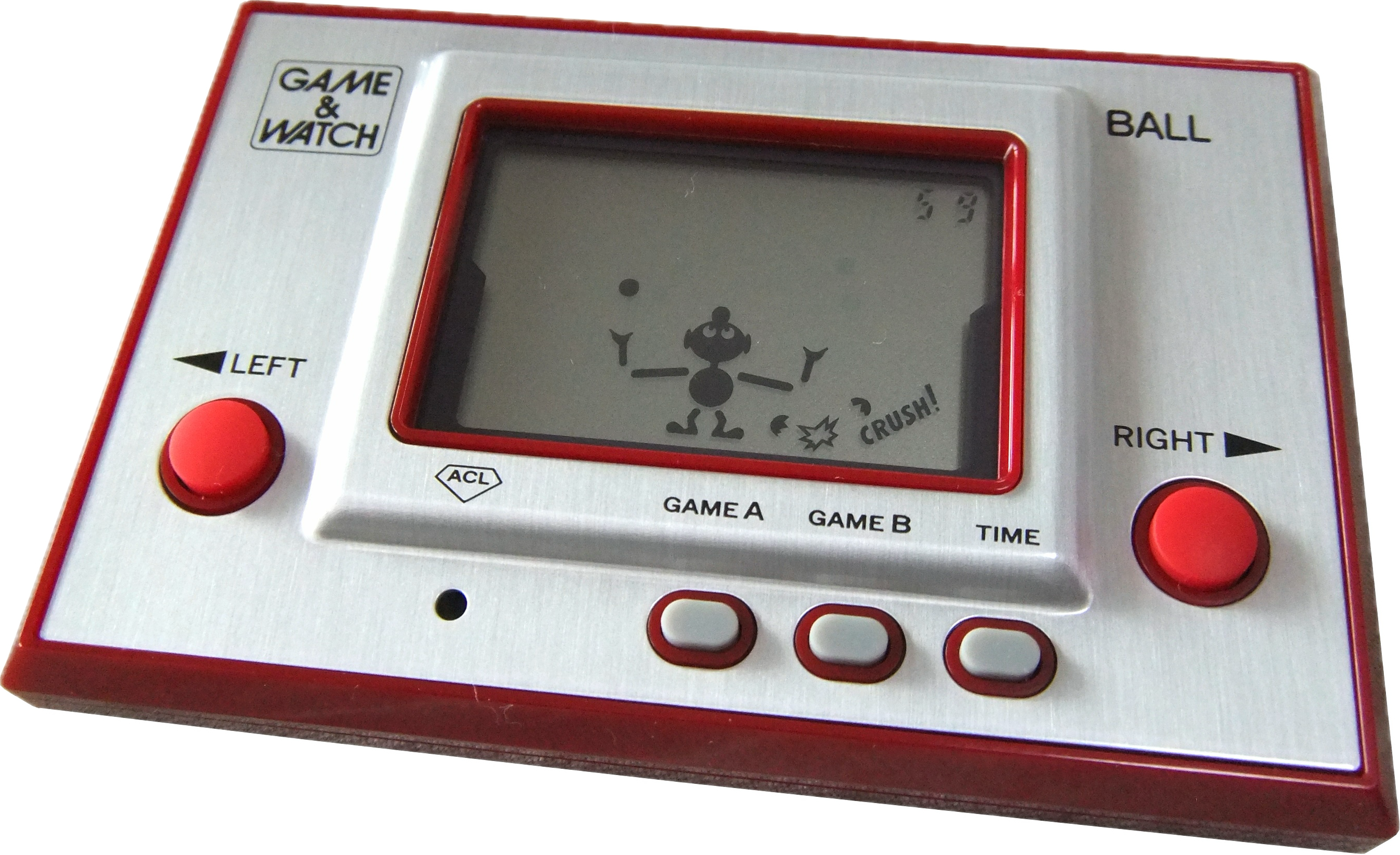
From 1980 to 1991, the Game & Watch line released 59 models and sold more than 43 million units worldwide. The retail price was only about 5,000 yen, yet the profit was immense. It even gave rise to the “D-pad” (cross directional pad) that later became the global standard for game controllers.
Thanks to a single flash of Yokoi’s insight, a batch of parts that might otherwise have been scrapped held up a market of more than 40 million units.
Q: Later, when developing the Game Boy, Yokoi even “deliberately” chose inferior technology. Why?
On pure spec, the Game Boy was already well behind the curve when it launched in 1989: a black-and-white screen, no backlight, and an 8-bit processor the computer industry had already retired.
But this was a deliberate choice, and the decisive factor was battery life. The Game Boy’s monochrome, non-backlight screen may have looked unimpressive, but on batteries alone it ran for over 30 hours — 6 to 10 times as long as the competition.
In other words, you could take it out for days without swapping batteries; and because the technology wasn’t new and the parts were cheap, the machine itself was affordable and the batteries cost far less too, so more players were willing to pick one up and give it a try.
What’s more, while the processor wasn’t new, there were still plenty of programmers who had written for 8-bit computers back in the 1980s, so development wasn’t especially hard either. With low cost driving sales, and game developers piling in on top, the Game Boy rode a virtuous cycle and took off in no time.
The result: the Game Boy line sold over 100 million units worldwide, leaving its technically more advanced color rivals far behind.
Yokoi’s winning method was to refuse to slug it out on “technical specs” — a battlefield someone else had chosen — and instead lure his opponents onto the terms he could own: portability, battery life, durability, and low price.
Q: So the next-generation “Virtual Boy” flopping — doesn’t that just prove this “old technology” philosophy is right?
On that point, the Virtual Boy is the perfect counter-example. It was Yokoi’s project after the Game Boy’s success — but this time he broke his own principle, using immature technology to try to deliver a stereoscopic 3D gaming experience.
The result was a disaster. Prolonged use of the Virtual Boy caused eye strain and headaches, and the machine had to sit on a desk with the user hunched over it, violating the most basic premise of “handheld” use. In the end it sold only about 770,000 units worldwide, and had to be discontinued six months later.
Same person, different philosophy, worlds apart in outcome. The lesson of the Virtual Boy is that when a company abandons its core philosophy and tries to substitute “impressing people with technology” for “meeting real needs,” it usually has to face very large risks.
Q: Yokoi’s story is decades old. In today’s world, where technology evolves non-stop, does this “old tech with a twist” approach still work?
In recent tech products, cases like Yokoi’s really have become rarer, for two reasons:
Technology advances too fast. Some “non-physical” old-tech products are easily emulated by newer ones — install an emulator on your phone and you get a “virtual Game Boy.” And with product life cycles now extremely short, old-tech hardware often can’t source parts and isn’t worth mass-producing; even when it can be made, it’s usually a limited-edition “nostalgia item” (like a reissued Famicom) rather than a mass-market bestseller.
It’s too easily copied. With today’s technology, even if some product becomes a hit, it’s quickly knocked off in bulk and sold so cheaply that the originator makes no money. Yokoi’s own Game & Watch was heavily copied in Taiwan back in the day — you could buy the knockoffs at stationery shops or night markets for a fraction of the original price.
But none of this means the “old tech with a twist” route is finished. In nostalgia goods, creative design collectives, and physical products that involve human interactions, old technology still has plenty of room to live.
Take a Taiwanese example: the “Ga-ji bag” (茄芷袋), woven from red, blue, and green plastic fiber — a product unchanged for decades, low on technology, and once even a symbol of “tackiness.” But with a mindset twist, plus media reach powered by new technology, it caught the retro wave that comes around every few decades, shed its “low-end” stigma, and became popular again.
This shift works both for old-technology in new products (Nintendo) and for old-technology in old products (the ga-ji bag). It may be hard today to duplicate Yokoi’s “repackaging surplus parts” success — but the point was never the technology. It’s the power of the brand, and the channels and target customers that brand connects to.
International luxury houses like Balenciaga and Louis Vuitton have introduced products in much the same style as the ga-ji bag, priced hundreds of times higher than the “original.” It looks absurd at first, and isn’t necessarily directly related to the Taiwanese bag — but it’s exactly what proves how much a powerful brand matters.
A closing thought
A game console, a rice cooker, a ga-ji bag — they look unrelated, but the same logic runs underneath: as long as you meet users’ real needs precisely and reliably, and find fresh meaning in old technology, you don’t necessarily need the newest tech.
Sometimes a “low-tech,” or even “no-tech,” solution is the best one — think of planting trees instead of installing a million-dollar sunshade.
And as the Game Boy shows, there’s a difference between “the value of innovation” and “value that comes from innovation”: a technical innovation (VR, a color backlight) doesn’t necessarily equal the product value the market actually wants (long battery life, a low price).
Yokoi once said: “A forgotten technology, with just a slight shift in thinking, can become a product everyone loves.” For marketers, the modern translation is simple: you don’t necessarily need the strongest technology — you need intuition and precise market insight.
(Note: this series is written with a book in mind, so some concepts will be developed further in other installments. Expect some jumping around. Stay tuned for what comes next — or wait for the book.)
Hardcore Insights
The essence of “outdated technology” is positioning first. Confirm what users genuinely care about (battery life, low price, durability), then pick the technology best suited to deliver it — rather than finding the technology first and hunting for customers afterward.
Don’t fall into the game someone else set. Yokoi refused to match Sega and Atari on specs and competed instead on portability, battery life, and price and won outright on his own terms.
The Game Boy’s “backwardness” was deliberate: a monochrome screen bought battery life 6 to 10 times longer than rivals’; it looked worse, but that was not customers’ concern at the time.
The Virtual Boy is the perfect counter-example: abandon the core philosophy, switch to immature technology to look “impressive,” and you’re gone in half a year.
What opportunity the environment hands you matters as much as what opportunity you can see: the Game & Watch used Sharp’s surplus scrap LCD inventory to build a market of 43 million units.
The approach still works today — the battlefield has just moved: tech products have grown scarce because they’re easy to emulate and easy to copy, but nostalgia, cultural-creative, and physical products still leave room for old technology. The real leverage is brand power and channels, not the technology itself.


