

The most common “active” work ethic is what I’d call precise delivery: do exactly what the boss or client asks — no more, no less. Do less and you get yelled at or don’t get paid. Do more and you feel like you’ve been taken advantage of. By management standards, this counts as “competent;” but from a marketing sense perspective, it almost always means uncompetitive.
If you’re already a manager, you might think that if every report from your crew could just deliver precisely without you chasing them, you’d consider it a small miracle. Fair. But you probably report to someone too — so it’s worth asking yourself the same question, honestly: can you do that?
What I want from a team is something a little higher: aim for around 120%, and make that the shared baseline. Once that becomes the team’s mental default, hitting “precise delivery” becomes the floor, and beating it becomes routine.
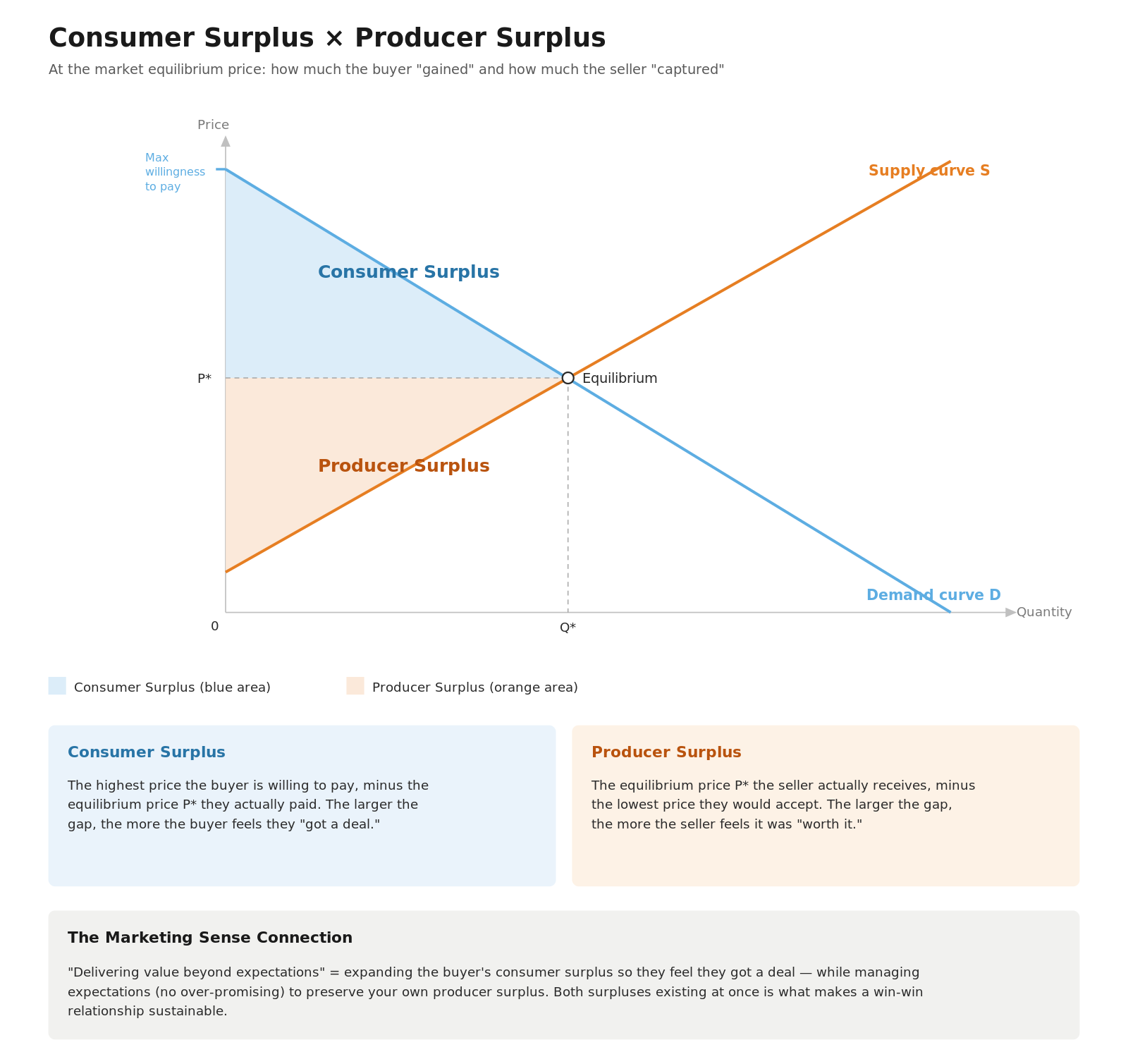
The 120% number isn’t pulled out of thin air. There’s a reason behind it, which I’ll get into more deeply in the book. If you want a head start, look up consumer surplus and producer surplus — basic economics, but oddly relevant here.
So why does marketing sense treat “precise delivery” as uncompetitive?
Because the point of marketing isn’t just hitting the target. It’s managing the gap between expectation and delivery.
In other words: one of marketing’s real powers is making the customer feel they got more than they paid for — while still happily paying the full price tag. (Making sure the product at least meets the expectation is the product team’s job.)
This “got a good deal” feeling sounds like something marketers cook up to hypnotize customers. But here’s the thing — it works just as well inside organizations, in consulting relationships, and in every collaboration with your boss or your colleagues.
Q: “Delivering more than expected” sounds great in theory — but a lot of employees’ first reaction is, “Isn’t this just asking me to do extra, or letting people treat me like cheap labor?” How do you respond to that?
That reaction is fair, but let me clear one thing up first: delivering more than expected does not mean running yourself at a loss.
In my own career, I’ve often spent maybe 80% of the effort I expected to spend, and still made the client feel they got more than 100% of the value. The trick isn’t working extra hard so the client pats you on the back and says “good job.” It’s learning to manage the expectation itself — which isn’t fixed. It can be shaped.
So I keep telling people running businesses: don’t over-promise. If you sell the moon during the pitch and pull expectations sky-high, you’ve worked against yourself before you’ve even started. The client now expects you to fly, but you can only run. Even if you run fast, they’ll still be disappointed.
The reverse works much better: if you say you walk steadily, then sprint a bit, the other side feels you’ve exceeded expectations. Do that consistently, and trust accumulates on its own.
Q: Where does customer expectation come from? If I want to shape it, where do I start?
Expectation comes from two sides:
Objective side: market dynamics and your read of the customer. Whatever your competitors deliver pretty much sets the baseline in the customer’s mind.
Subjective side: the “mental preparation” you do for the customer — how you use communication and marketing to set a reasonable expectation before they ever engage with you.
Here’s an important concept: your product might only solve 80% of the customer’s real need. But if it lands 20% above their expectation, they’ll still feel it’s a good deal. “Perfect” isn’t the target. “Better than expected” is.
In economics, this is consumer surplus: what the customer was willing to pay, minus what they actually paid — the part that feels like winning. Your job isn’t to lower the price. It’s to make them feel a bigger surplus.
The same logic applies on your side. You also need to keep a reasonable producer surplus: your price should sit comfortably above the effort you’re putting in. This is why race-to-the-bottom bidding is a vicious cycle for sellers — either you hand your rightful margin over to the client, or you grind yourself down. Neither is sustainable.
Even if you’re a plain-vanilla employee with no bargaining power (short of switching jobs), the simplest version goes like this: promise your boss (at 100% expectation) only what you can do with 80% effort, then spend 90% of your effort and surprise them with a 120% outcome.
That might pay off immediately. It might not — I won’t guarantee anything. But I’m convinced that when you eventually need to compete with someone else, those quietly accumulated reserves of goodwill end up mattering.
(About race-to-the-bottom pricing: in the real world there are variations — heavily subsidizing prices to push competitors out, grabbing market share, then the classic raise-and-trap on consumers. That’s a risky and costly path, and it’s not a game most of us can afford to play, so let’s set it aside as an exception.)
Q: This logic sounds to work externally — designed for customers. Does the same thing actually apply inside an organization, or in a consultant-client relationship?
It applies completely. And I think the internal application is where this idea gets ignored the most.
In my corporate years, and now in my consulting work, I’ve made “consistently delivering 120% value” a baseline principle. This isn’t about underselling yourself. It’s about earning trust. For consultants — and anyone whose work depends on trust — that trust is the basic condition for long-term collaboration, and for being allowed into sensitive decisions.
The same applies inside an organization. If you can do a little more in every collaboration — finish the work, then flag a risk your boss hadn’t spotted, or suggest a workflow that saves her time — what you accumulate isn’t gratitude. It’s their trust in your professional judgment. And that kind of trust, plus the “consistently better than expected” experience it builds, is worth more than any short-term performance number.
Inside a company, this is how you market yourself — and your work ethic. Who said marketing was only for tricking customers?
A closing thought
For any function, “tools are accelerators, not steering wheels.” That’s something I say often when I talk about marketing sense.
In an era where digital tools change weekly, it’s easy to get distracted by algorithms, new ad formats, or some shiny new AI capability. But the competitive edge that doesn’t expire is still your understanding of, and commitment to, value.
Consistently delivering more than expected isn’t a one-off move. It’s a sustained mindset. Once that mindset becomes a habit, trust comes easier, and long-term relationships face less friction — whether the other side is a customer, a colleague, or a boss.
(Note: this series is written with a book in mind, so some concepts will be developed further in other installments. Expect some jumping around. Stay tuned for what comes next — or wait for the book.)
Hardcore Insights
“Precise delivery” is competence, not competitive advantage. The point of marketing sense is to manage the gap between expectation and delivery — so the other side feels they got a deal.
“Beyond expectations” doesn’t mean working at a loss. Expectation itself can be shaped. Don’t over-promise, and 80% of your effort can create 120% of the felt value.
Customer expectation has two sources. The objective baseline is set by your competitors; the subjective layer comes from your communication and positioning. Both can be actively managed.
Consumer surplus + producer surplus. Make them feel they won, while keeping your fair margin. Win-win is sustainable. One-sided sacrifice isn’t business.
The same logic applies inside the organization. Consistently delivering slightly more than expected to your boss or colleagues builds trust — and trust is harder to replace than any short-term performance number.
YouTube
English:
Chinese:


